
 English
Ask any engineer who designs ski cores, drone airframes, paddle blades, or protective helmet shells what keeps them up at night, and the answer is almost always the same trade-off: how do you cut weight without giving up impact toughness? Pure carbon fiber is the obvious first choice — it is stiff, light, and looks the part on a spec sheet. But carbon fiber has a well-documented weakness that only shows up the moment it matters: under a sharp, low-velocity impact, it tends to fail by brittle fracture rather than absorbing the energy gracefully, which is exactly the failure mode that ends a ski run, cracks a drone shell mid-flight, or compromises a helmet on impact.
1. Why Pure Carbon Fiber Falls Short Under Impact
Recent laboratory research on carbon fiber laminates confirms what field failures have been showing designers for years: when a carbon fiber panel is struck perpendicular to the fiber direction, it is prone to sudden, brittle fracture that compromises the structural integrity of the whole part rather than just the impact point (ScienceDirect, Failure Mechanism of Carbon/UHMWPE Hybrid Laminates Under Ballistic Impact). That is a real problem for any application where a single impact — a rock strike on a ski base, a hard landing on a drone frame, a fall on a bike — needs to be survivable, not just theoretically strong on paper.
The instinctive fix, adding more carbon plies, only makes the part heavier and stiffer without solving the underlying issue: carbon fiber has very little strain-to-failure. It simply does not stretch or flex enough to dissipate a sudden impact load before it cracks.
2. The Hybrid Fix: Borrowing Toughness From High-Modulus PE
This is where high-modulus polyethylene (PE / UHMWPE) unidirectional fabric earns its place in the layup. UHMWPE fiber is produced through a gel-spinning process that aligns extremely long polymer chains, giving the fiber an exceptional strength-to-weight ratio along with high elongation and energy-absorption capacity — properties that sit almost opposite to carbon fiber’s brittleness. Blend the two into a single laminate, and the resulting hybrid structure behaves fundamentally differently under load than either material alone.
Peer-reviewed testing on carbon fiber / UHMWPE hybrid laminates backs this up directly: in low-velocity impact trials, hybridized panels showed measurably higher peak load capacity and impact energy absorption than carbon-only laminates of comparable weight (Wiley, Low-Velocity Impact Properties of Carbon Fiber/UHMWPE Hybrid Composites). In practical terms: the carbon fiber layers hold the shape and rigidity, while the PE UD layers act as an internal shock absorber, catching the crack propagation that would otherwise run straight through an all-carbon shell.
This is the same “rigid-plus-resilient” logic that has quietly shaped body armor design for decades, where hard carbon or ceramic strike faces are almost always backed by a high-modulus PE UD layer to catch fragments and absorb residual energy after the initial impact. Extreme sports equipment and drone airframes are simply the newest fields to rediscover a principle that ballistic engineering proved a long time ago.
3. Interlaminar vs. Inner-Laminar: How the Fibers Are Arranged Matters Too
Hybridizing carbon fiber and PE is not just a matter of picking a ratio — how the two fibers are arranged relative to each other inside the laminate changes the outcome almost as much as the ratio itself. Composite researchers generally distinguish two approaches: interlaminar hybridization, where whole plies of carbon and whole plies of PE UD are stacked in an alternating sequence, and inner-laminar (or intra-ply) hybridization, where carbon and PE fibers are blended within the same ply. Published comparisons of the two constructions found that the inner-laminar approach produced the highest measured impact strength of the hybrid systems tested, peaking at a PE fiber content of roughly 43% by weight relative to carbon, while bending, compressive, and interlaminar shear strength continued to scale with carbon fiber content across both constructions.
The practical takeaway for a product designer is that a “hybrid UD fabric” is not a single, fixed thing — the stacking sequence, the PE-to-carbon weight ratio, and the resin system all need to be selected together, tuned to whether the part needs to prioritize raw stiffness (favoring carbon-rich, interlaminar builds) or impact survivability (favoring PE-rich, inner-laminar or skin-core builds). A supplier that only offers one fixed hybrid ratio is really only solving one type of impact problem, not the range that sports equipment and aerospace components actually face in the field.
4. Where the Hybrid Approach Is Already Showing Up
A few application areas illustrate why this hybrid direction is gaining traction outside the defense sector:
• Drone and UAV shells: airframe designers are increasingly combining fiber types rather than relying on a single reinforcement, using carbon for structural stiffness in arms and frames while adding a tougher fiber layer specifically to protect against crash and collision damage (RoboticsBiz, Drone Airframes and Lightweight Composite Materials). A hybrid carbon/PE UD shell follows this exact logic — rigid enough to hold the airframe geometry, tough enough to survive a hard landing without spider-cracking.
• Ski and snowboard cores: sandwich constructions that pair a carbon fiber top skin with a PE UD interlayer resist edge and base impacts from rocks and hard landings far better than a carbon-only laminate of the same thickness.
• Paddle blades and bike frames: components that take repeated, unpredictable knocks benefit from a hybrid layup that keeps flex response predictable instead of cracking after one hard hit.
• Protective helmet shells: outer shells built from a carbon/PE UD hybrid combine a hard, abrasion-resistant strike face with an inner layer engineered to absorb and spread impact energy rather than transferring it straight through to the wearer.
5. What Actually Determines Whether a Hybrid UD Fabric Performs
The idea of blending carbon fiber with high-modulus PE is well established in the literature. The part that separates a laminate that performs from one that quietly underperforms is manufacturing precision — something that rarely shows up on a datasheet but decides everything in the field. Two variables matter most:
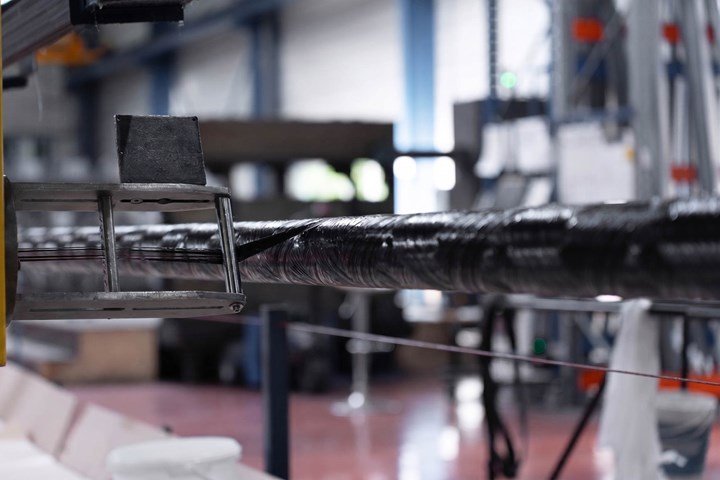
• Fiber tension control across the layup line. UD fabric is built from fiber laid down under constant, even tension. A single point of drift — a loose spool, an inconsistent feed — creates a soft spot in the finished panel that a visual inspection will never catch. This is precisely the kind of process control our team documented in a recent breakdown of what large-scale, tension-controlled UD fabric production actually looks like on the factory floor.
• Fiber grade and resin ratio matched to the application. Not every project needs the same PE fiber modulus or the same carbon-to-PE ratio. Our UD non-woven fabric line is engineered across multiple GSM and ply constructions specifically so the hybrid ratio can be tuned to the impact profile of the finished product, rather than forcing every customer into a one-size-fits-all layup.
On the raw fiber side, our ultra-high-strength PE fiber series spans multiple grades — from J99 through J300 — with tensile strength up to ≥39 cN/dtex and modulus up to ≥1,500 cN/dtex, giving composite engineers a real range of stiffness-to-toughness combinations to hybridize with carbon fiber, rather than a single fixed-spec product.
Put simply: the fiber science behind carbon/PE hybrids is now well proven across ballistic, aerospace, and industrial research, but the science only translates into a working product when the supplier can execute it consistently at production scale, not just in a one-off lab sample.
6. What to Ask a Hybrid UD Fabric Supplier Before You Commit
• Can they show a documented, tension-controlled production process, not just a lab-tested sample panel?
• Do they manufacture the base PE fiber themselves, or resell material sourced from a third party?
• Can the carbon-to-PE hybrid ratio and areal density be customized to your product's specific impact and weight requirements?
• Can they support the MOQs and cutting tolerances that a prototyping or short-run sports/aerospace project actually needs?
Ready to Hybridize Your Next Composite Shell?
Nantong Yankaian New Materials develops customized, high-modulus (100 GPa+) PE UD prepreg reinforced with carbon fiber, purpose-built for lightweight, high-impact applications like drone shells, sports equipment, and protective gear. Backed by our own fiber production and a tension-controlled, large-scale UD layup line, we tailor the carbon-to-PE hybrid ratio, GSM, and resin system to your product's exact impact profile — not a generic off-the-shelf laminate. Whether you're prototyping a new ski core or scaling up drone shell production, our team can match a hybrid UD construction to your spec and back it with consistent, factory-audited quality at volume. Get in touch with our engineering team to discuss your project.